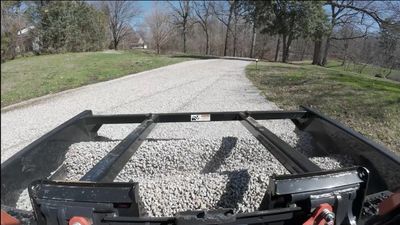
GRAVEL DRIVEWAY DRAINAGE PROBLEMS IN SOUTHERN INDIANA
Why More Southern Indiana Driveways Are Washing Out
If your gravel driveway seems to wash out more often than it used to, you're not alone.
Across Southern Indiana, I'm seeing heavier rain falling in much shorter periods of time. Instead of a gentle rain lasting most of the day, many storms now produce intense downpours that send large amounts of water across hillsides, yards, and driveways all at once.
Many older driveways were never designed to handle that much runoff in such a short amount of time.
Because of this, problems that were once uncommon are becoming much more frequent.
Today I often see:
- Driveways washing out after heavy storms.
- Standing water that never used to be there.
- Deep ruts caused by fast-moving runoff.
- Soft spots from trapped water beneath the gravel.
- Culverts needed in locations that never required one years ago.
Adding more gravel may temporarily improve the appearance, but it usually doesn't solve the real problem. That's why every driveway should be evaluated before spending money on more stone. Finding where the water is coming from is almost always the first step toward a lasting repair.
The Real Problem Is Water
Most gravel driveway failures begin with poor drainage, not a lack of stone.
Every property handles water differently. Before recommending a repair, I look at how rainwater naturally moves across your property.
In many cases, the solution may include:
- Raising the driveway above the surrounding ground.
- Restoring the proper crown so water sheds off the surface.
- Installing drainage swales to safely carry runoff away.
- Adding or replacing culverts where water naturally crosses the driveway.
- Correcting low areas where water collects beneath the stone.
Sometimes one of these solutions is enough. Other times several work together to protect the driveway for years to come.
Trees Can Also Create Drainage Problems
One issue many homeowners never consider is the effect of mature trees growing close to a driveway.
Over time, tree roots and expanding root flares can slowly raise the surrounding ground. What once allowed rainwater to flow naturally away from the driveway can eventually become a barrier that traps water against it.
In some situations, those changes redirect runoff directly across the driveway instead of away from it.
Understanding how the landscape has changed over the years is often just as important as repairing the driveway itself.
Every Driveway Is Different
There isn't a one-size-fits-all solution.
Every property has its own terrain, drainage patterns, and challenges. That's why I take the time to evaluate what's actually causing the problem before recommending a repair.
My goal isn't simply to spread more gravel.
It's to build a driveway that handles water correctly, lasts longer, and requires less maintenance over time.
Every driveway has a story. Water always leaves clues. My job is to find those clues, solve the drainage problem, and build a driveway that performs for years to come. If your driveway is washing out, holding water, or simply isn't performing like it should, I'd be glad to take a look.